DevOpsAWSLinuxeBPFHardwareDesign Systems

Architectural Master Blueprint: Engineering High-Density Systems

2026-10-06·16 min read
Abundant JoelAbundant Joel
Architectural Master Blueprint: Engineering High-Density Systems

Executive Abstract & Sidenotes

High-performance distributed systems are not engineered in a vacuum. When designing infrastructure that must survive catastrophic datacenter partitions, every abstraction layer—from the Linux kernel syscall table to the client-side typographical hierarchy—must be scrutinized with relentless precision.

In high-reliability engineering, latency is not merely a performance metric; it is an early indicator of memory fragmentation and network saturation.

Developers can navigate the system console by pressing ⌘K or by executing Ctrl + C to abort stuck routines. Crucially, stateless compute nodes eliminate configuration drift entirely[1].

Route 53 Application Recovery Controller isolates consensus health checks outside payload regions, dropping failover times from minutes to under 6 seconds.
In-region CloudWatch alarms cannot be relied on during regional blackouts because the telemetry plane suffers the same power failure as the host compute.

Blueprint Tech Stack Matrix

The engineered toolchain rendered with hairline dividers and alternating checkerboard cells:

Infrastructure Nodes

AWS
Docker
Linux
Terraform
Kubernetes
Python
C++
ESP32

Production Kernel Hook & Tabbed Code

Line-numbered terminal with selective line highlighting:

ebpf_security_probe.c
1#include <linux/bpf.h>
2#include <bpf/bpf_helpers.h>
3
4struct sys_enter_execve_args {
5 unsigned long long unused;
6 int syscall_nr;
7 const char *filename;
8};
9
10SEC("tracepoint/syscalls/sys_enter_execve")
11int trace_execve(struct sys_enter_execve_args *ctx) {
12 char comm[16];
13 bpf_get_current_comm(&comm, sizeof(comm));
14
15 u32 pid = bpf_get_current_pid_tgid() >> 32;
16 bpf_printk("ZeroMerge: Trap execve PID %d (%s)\\n", pid, comm);
17
18 return 0;
19}
20
21char LICENSE[] SEC("license") = "GPL";

Or toggle between implementation choices with our tabbed code snippet:

routing-infrastructure
resource "aws_route53_health_check" "primary" {
  fqdn              = "api.zeromerge.dev"
  port              = 443
  type              = "HTTPS"
  resource_path     = "/healthz"
  failure_threshold = 2
  request_interval  = 10
}

Declarative Git Infrastructure Diff

Clear visual review of changed configuration layers with additions and removals:

modules/cloud/vpc_peering.tf
module "transit_gateway" {
name = "zeromerge-core-tgw"
- enable_auto_accept_shared_attachments = false
+ enable_auto_accept_shared_attachments = true
+ enable_multicast_support = true
}

High-Resolution Zoomable Schematics

Click the schematic below to view in full resolution without leaving the reading flow:

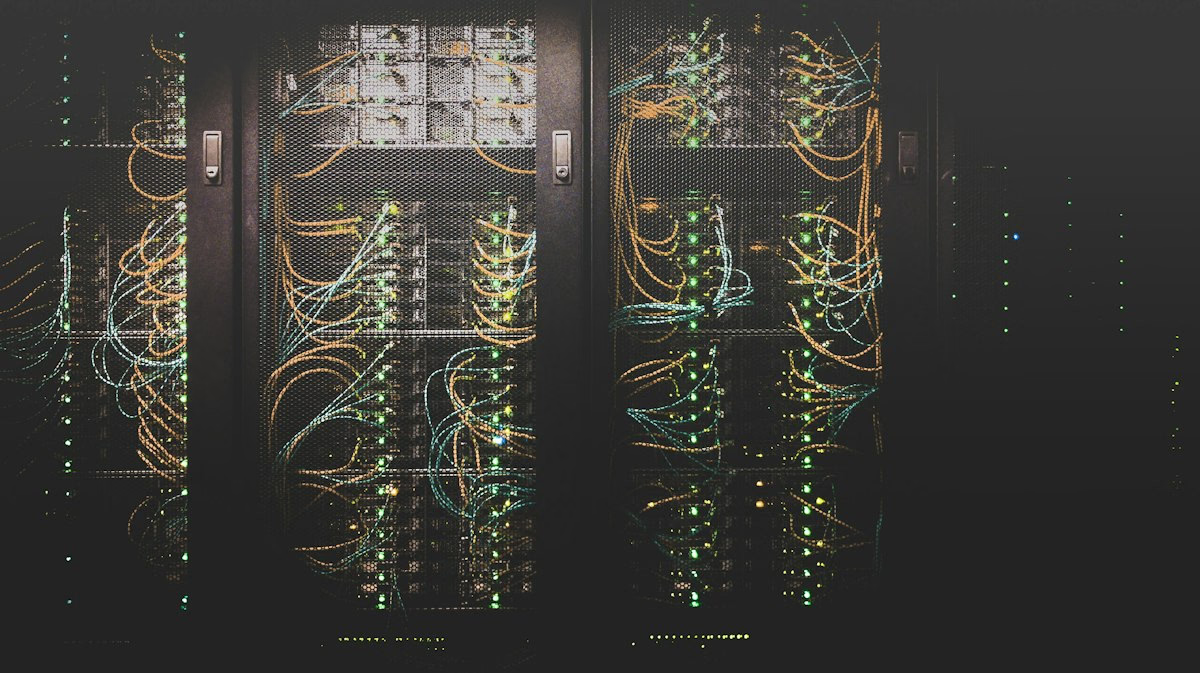
Cloud Ingress & High-Density Datacenter Bay
Fig 1.1: Core Cloud Transit Infrastructure Bay in Frankfurt (eu-central-1)

Before & After Comparison Slider

Drag the interactive handle left/right to compare raw pixel matrix with 1-bit thermal output:

Raw Camera Capture1-Bit Monochrome Thermal Output (384px)
1-Bit Monochrome Thermal Output (384px)Raw Camera Capture
↔

Step through the hardware prototyping stages:

1 / 3
Initial ESP32 memory mapping and UART baud rate allocation.

Initial ESP32 memory mapping and UART baud rate allocation.

ASCII Microcontroller Wiring Bus

Precise, lightweight hardware schematics that render consistently across devices:

+------------------------+ +------------------------+\n| ESP32 MICROCHIP | | 58mm THERMAL HEAD |\n| | | |\n| [GPIO 16] (RX2) <----+----> [TX] | Baud: 9600 bps |\n| [GPIO 17] (TX2) ----+----> [RX] | Parity: None (8N1) |\n| [GND] -----------+----> [GND] | Strobe Time: 65us |\n+------------------------+ +------------------------+\n |\n [EXTERNAL 5V 2.5A DC]} />

Multi-Tier Failure Recovery Matrix

“If you haven't deliberately pulled the power cable from your primary database rack this month, your disaster recovery plan is merely a wish list.”

Production Hardening Checklist

✓Lock Route 53 health check probes to independent IP CIDRs
✓Verify eBPF kernel bytecode verification passes with zero unbounded loops
✓Enforce Floyd-Steinberg error diffusion for all thermal raster dumps
✓Conduct quarterly cross-Atlantic simulated fiber severance test
Examine CAP Consistency Proof & Monotonic Clocks▶
Under total transatlantic fiber severance, maintaining Availability requires sacrificing immediate linearizability. By utilizing monotonic Lamport timestamps alongside optimistic locking, transactions remain non-blocking while conflict-resolution heuristics settle state asynchronously.

Core Principles & Related Systems

Master Architecture Principles

Resilience

Failure Domains as Default

Never engineer assuming the network will remain stable. Build isolated, self-healing cells.

Observability

Kernel-Level Observability

Userspace logging is too slow for line speeds. eBPF gives zero-overhead kernel insight.

Hardware

Physical Constraints Ground Focus

When infinite screens produce cognitive overload, physical 384px receipts restore craft.

DevOps

Declarative Immutability

Never configure production servers by hand. Terraform blueprints make deployments repeatable.

PaperTask: Thermal Receipt Automation Engine

Notion to Thermal Printer (384px)

The hardware and cloud bridge converting digital task backlogs into physical 384px receipts using ESP32 firmware and AWS EventBridge.

AWSESP32PythonC++

Read My Next Note